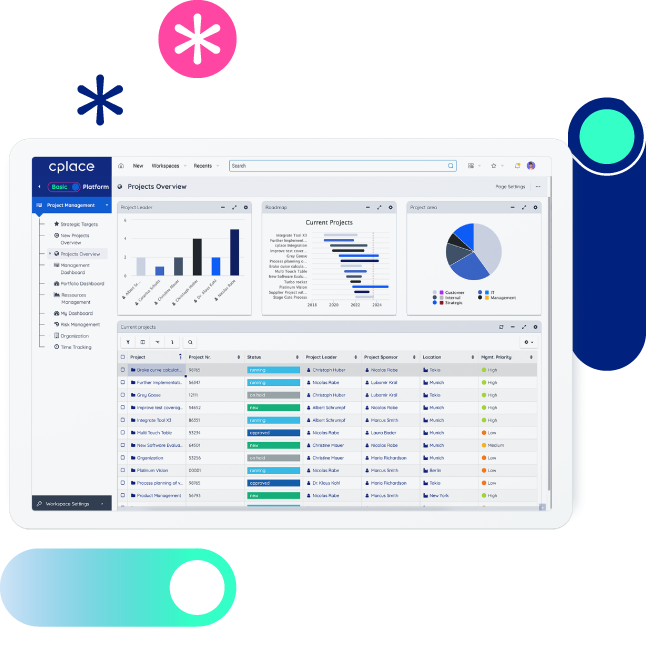
Project Management Software for Mechanical Engineering
The evolution from a pure product manufacturer to an intelligent solution provider ensures long-term success in mechanical and plant engineering. A high level of technical expertise and the seamless cooperation between all specialist departments, as well as the implementation of an AI-powered project and portfolio management software (PPM), guarantee the successful implementation of complex engineering projects.
White Paper: cplace for the Engineering Industrycplace: PPM Software for the Mechanical and Plant Engineering Industry
cplace is the Next Generation Project and Portfolio Management Software for the mechanical and plant engineering industry, enabling companies to plan, manage, and prioritize complex development projects with transparency. In mechanical engineering project management in particular, dependencies between development, design, procurement, production, and management are especially high. cplace provides transparency regarding deadlines, resources, milestones, and risks—from individual projects to multi-project management.
Innovative companies in the mechanical and plant engineering industry place their trust in cplace.
Request Demo

cplace has proven to be a user-friendly, lean, and flexible solution. We were determined to avoid being dependent on a provider offering a custom-developed solution in a “black box” that would limit our range of options. cplace, with its Shared Source approach, is a positive exception in this market.

Project Management Challenges in Mechanical and Plant Engineering
Mechanical and plant engineering projects are characterized by a high degree of complexity and customization—from special-purpose machine manufacturing to turnkey plant design. Errors in the design phase, delays in the procurement process, or coordination problems between mechanics, electrics, and software development can lead to significant cost overruns and schedule delays.
The close integration of specification creation, design (CAD/CAM), bill of materials (BOM) management, manufacturing, assembly, and commissioning requires the use of a powerful solution for Next-Generation Project and Portfolio Management to effectively plan, execute, and manage all development and customer projects across teams.
Technical complexity and variety of variants
Engineering projects in mechanical engineering encompass numerous disciplines such as mechanics, electrics, pneumatics, hydraulics, and control technology, which must be developed and integrated simultaneously. The coordination of assemblies, bills of materials (BOM), and technical changes (ECR/ECO) requires consistent project controlling with clear milestone management.
Change management and flexibility
Late changes in the design process, whether due to customer requirements, supplier issues, or optimization potential, have a direct impact on schedules, material requirements, and production capacities. Structured change request management is essential to minimize the impact on the critical path.
Resource and capacity management
Efficient planning and utilization of designers, manufacturing capacities, test benches, and assembly personnel is essential. Skill-based resource planning and capacity leveling across multiple projects prevent bottlenecks and ensure on-time delivery for parallel orders.
Supply chains and external dependencies
Global supply chain disruptions, long procurement times for special components, and dependencies on suppliers require forward-looking risk management. Integrating procurement milestones into project planning is critical to project success.
Technological change and digitalization
The integration of Industry 4.0 technologies, IoT sensor technology, predictive maintenance, and digital twins in machines and plants requires new development skills and agile methods in traditionally phase-oriented projects.
Capex projects and investment controlling
High investment costs (CAPEX) for special-purpose machines and plants, combined with rising operating costs (OPEX) due to material and skilled labor shortages, require precise project budget controlling and earned value analyses to ensure profitability.
Whitepaper
Next-Generation Project and
Portfolio Management for the
Mechanical and Plant Engineering
Industry
Download Whitepaper!

Why Is cplace the Ideal PPM Solution for Companies in the Mechanical and Plant Engineering Sector?
cplace enables transparent project and portfolio management for the efficient control of investments in research, development, and customer projects:

Enterprise-wide visibility and centralized database
cplace creates a single source of truth that consolidates information from design, work preparation, purchasing, and manufacturing. All project participants, from designers to project managers, have access to up-to-date, consistent data. Integrated dashboards provide real-time insights into project progress, milestone status, and budget utilization.

Acceleration of innovation processes
The integration of all project data breaks down silo structures between development, design, and manufacturing. cplace AI analyzes project progress and identifies potential for optimization, enabling new machine concepts to be developed, tested, and brought to series production more quickly.

Optimization through digitalization and AI
cplace combines key digital technologies such as artificial intelligence and cloud computing to effectively process large amounts of data from CAD systems, PLM solutions, and ERP systems. cplace AI supports the analysis of project risks, the forecasting of schedule deviations, and automated report generation—while ensuring the highest cybersecurity standards to protect sensitive design data.

Flexible mix of methods for complex projects
Whether it’s a classic waterfall model with stage gates, agile development according to Scrum, or hybrid approaches—each team works in individual solution modules. Gantt charts with dependencies and critical paths can be seamlessly connected to Kanban boards and sprint backlogs to flexibly manage complex development projects.

Cross-company collaboration
cplace enables cross-company collaboration with suppliers, engineering service providers, and technology partners—without media discontinuity and in real time. Secure planning portals and standardized workflows ensure consistent project information along the entire value chain.

Resource planning—transparent, flexible, and AI-supported
cplace enables transparent resource planning across all projects. cplace AI supports skill-based resource allocation and identifies capacity bottlenecks at an early stage. Management dashboards provide a holistic overview of utilization and availability—from the design department to assembly.
cplace Highlights for Next-Generation Project and Portfolio Management
High acceptance through intuitive operation
With cplace, project managers, designers, and department heads can tailor flexible applications to their individual needs—without any programming knowledge. Proven features such as Gantt charts with critical paths, Kanban boards for agile work packages, milestone trend analyses, resource histograms, and management dashboards increase user acceptance and ensure a fast learning curve.
Focus on users and teams
Fast time to value
Ready-to-use building blocks, solution templates, user-centricity, method diversity, and quick and easy adaptability through no-code/low-code ensure that companies can quickly benefit from cplace, from the first pilot project to the company-wide rollout.
cplace toolkit at a glance
Individual mix of methods—agile, classic, or hybrid
cplace connects development teams, project management, and production planning that follow different project management methodologies. The design team works in phases using stage-gate processes, while software development is working agilely according to Scrum or SAFe—cplace synchronizes all projects in a higher-level master plan with consistent milestone management.
A comparison of project management methods
Holistic approach to project management
Professional project management in mechanical engineering encompasses numerous disciplines such as demand management, offer calculation, scheduling, resource management, risk management, cost and budget planning, and strategic portfolio management. cplace provides suitable solution modules for all disciplines and maturity levels, which can be flexibly combined. Best practice templates, such as those for integrated maturity management, accelerate implementation.
cplace platform overview
cplace AI as intelligent project assistance
cplace AI supports and relieves project managers and resource managers through intelligent automation. The AI-supported assistant analyzes project data, identifies risks and bottlenecks at an early stage, and provides data-based recommendations for action. cplace AI supports optimal resource allocation, creates automated status reports, and forecasts schedule deviations—leaving more time for value-adding engineering activities.
cplace AI
No room for shadow IT
The single source of truth for all project data enables resource-efficient work, optimized development processes, and faster time-to-market for new machines and systems.
Leave shadow IT behind
Typical Use Cases for Project Management Software in Mechanical Engineering
Managing development projects in mechanical engineering
cplace helps companies centrally plan and transparently manage complex development projects involving many different departments. This allows teams to keep track of milestones, project status, and risks at all times.
Multi-project management for mechanical engineering companies
When several projects run in parallel, cplace creates transparency across priorities, dependencies, and bottlenecks. This enables better-informed decisions in cross-project management.
Planning resources and capacities in engineering
With cplace, scarce engineering resources can be planned across projects and workloads can be managed more effectively. Bottlenecks become visible early, before they lead to delays.
Making milestones and dependencies transparent
cplace makes critical relationships between tasks, teams, and project phases visible. This helps companies identify the impact of delays early and respond in a targeted way.
Digitally mapping product development processes
From requirements to implementation, cplace helps structure and map product development processes in a transparent and traceable way. This improves visibility, coordination, and control.
Improving cross-functional collaboration
cplace creates a shared view of projects for development, design, purchasing, and production. This reduces coordination effort and enables faster decision-making.
Success Stories of Our Customers


Frequently Asked Questions:
cplace in the Mechanical and Plant Engineering Industry
cplace supports you in overcoming industry-specific PPM challenges:
- Complex multi-project management with numerous parallel development and customer projects
- Engineering change management for structured control of technical changes (ECR/ECO)
- Milestone and gate control for phase-oriented development processes
- Resource planning across design, manufacturing, and assembly
- Compliance with regulatory requirements such as machine directives, CE marking, and industry-specific standards
cplace supports compliance through several key features and certifications:
Security and quality standards
cplace meets the highest security requirements through certifications such as ISO 27001 (Information Security) and ISO 9001 (QualityManagement). Regular penetration tests according to OWASP standards minimize security gaps.
Audit trail and traceability
Seamless tracking of all project decisions and data changes. Automatic logging serves as evidence for quality audits, customer approvals, and certifications.
Regulatory compliance support
cplace supports the implementation of regulatory requirements such as the Corporate Sustainability Reporting Directive (CSRD). Automated data integration, report templates, and analyses facilitate compliance with current standards.
Cloud compliance and data security
GDPR-compliant cloud solution with single-sign-on (SSO) and integration of directory services—for secure collaboration and agile work processes.
Accelerating innovation processes
cplace provides transparent project and portfolio management, overcomes data silos and supports fast decisions based on valid data. cplace AI analyzes project progress and identifies potential for optimization to shorten time-to-market cycles.
Flexible adaptation to market conditions
The no-code/low-code platform can be quickly adapted to changes in customer requirements or new technologies—without costly IT projects.
Optimization of technological advances
cplace integrates data from PLM, ERP, and MES systems and supports the development of digital twins and Industry 4.0 applications through consistent project data management.
cplace is the ideal PPM solution for global engineering companies with distributed development and manufacturing sites:
Company-wide transparency
A central database (single source of truth) consolidates project information from all sites. Decentralized teams have access to up-to-date, consistent data.
Cross-Company Collaboration
Secure collaboration with suppliers and engineering partners through standardized processes and controlled access rights.
Flexible mix of methods
Each location can use locally optimized workflows, while overall project management is handled centrally.
Enterprise scalability
The cplace architecture enables seamless scaling and meets the highest requirements for data security and performance.
cplace offers APIs and preconfigured interfaces for common industry solutions to keep data synchronized and break down silos between R&D, production, and controlling.
Standardized REST APIs and preconfigured connectors ensure seamless data exchange without media discontinuity.
Yes, cplace offers comprehensive functions for resource planning and bottleneck avoidance:
- Skill-based resource allocation according to professional expertise (mechanics, electrics, PLC, etc.)
- Capacity balancing across multiple projects with utilization histograms
- AI-supported forecasts by cplace AI for early detection of bottlenecks
- What-if scenarios for simulating resource shifts
- Intuitive dashboards with early warning indicators for overloads
Yes, cplace is designed as a flexible platform:
- No-code: Project managers and business users create their own views, dashboards, and simple workflows.
- Low-code: Power users configure automations and integrations.
- Pro-code: IT teams implement in-depth customizations and enterprise integrations.
This allows company-specific stage-gate processes, approval workflows, and reporting structures to be mapped precisely.
A minimum viable product (MVP) can often be delivered within 20 days, followed by an iterative refinement with stakeholders.
Standardized cplace solutions can be introduced within a few weeks, provided that the company actively participates in the implementation and provides the necessary human resources.
You Might Also Be Interested In