Project Online Is Being Retired: 10 Reasons Why cplace Is the Best Alternative
May 15, 2026 | 6 min
Microsoft has announced that it will permanently retire Project Online on September 30, 2026. Companies need to act now. Those who use this end as an opportunity can fundamentally modernize their project and portfolio management (PPM). In this article, we present 10 reasons why cplace is the ideal Project Online alternativ
At a Glance: Project Online vs. cplace
| Criterion | Project Online | cplace |
|---|---|---|
|
Methods |
Primarily classic (waterfall) |
Classic, agile, and hybrid |
|
Customizability |
Limited, IT-dependent |
No-Code and Low-Code (Citizen Development) |
|
Usability |
Outdated, operable only by experts |
Modern, role-specific workspaces |
|
Portfolio management |
Basic functions, no further development |
Strategic portfolio management with dashboards and roadmaps |
|
AI capabilities |
No native AI assistants in the product |
cplace AI: Chat, Assistants/Agents, and MCP |
|
IT integration |
SharePoint/MS-centric |
REST API, Generic Interface, best-of-breed |
|
Future-proofing |
End of life on Sep 30, 2026 |
Adaptive platform, continuous evolution |
|
Data foundation |
Fragmented by shadow IT |
Single source of truth |
|
Compliance & security |
Microsoft standard |
Audit-proof, GDPR, sophisticated role and rights model |
1. Project Online Is a Legacy Tool With No Future
Project Online was launched in 2013 and has since shown significantly less product momentum than modern PPM platforms, and is being phased out in the long term. For companies, this creates planning uncertainty on the one hand. On the other hand, they are working with a technology that no longer meets the demands of modern project work.
cplace, in contrast, is continuously evolving as an adaptive PPM platform and is among the leading European PPM solution providers.
2. Hybrid Project Management Instead of Pure Waterfall
Project Online is primarily designed for classic, plan-driven project management; agile workflows require additional tools or integrations. However, day-to-day project work in companies is hybrid: teams use waterfall, Scrum, Kanban, or a mix of these. When a tool enforces only one method, employees fall back on Excel and other shadow-IT solutions.
cplace supports methodological diversity across the enterprise. For each project, the most suitable method can be selected and modeled in cplace: classic, agile, or hybrid. All information flows into a central data foundation, so the overview of the company-wide project landscape remains intact.
3. No-Code and Low-Code Instead of IT Dependency
Customizations in Project Online are time-consuming, require specialist knowledge, and create strong dependence on external service providers—often combined with expensive maintenance contracts. In addition, these customizations cannot easily be transferred to other Microsoft products.
cplace relies on citizen development: business units can adapt their solutions themselves using no-code and low-code—without help from the IT department. Modules are assembled like building blocks or used as ready-to-deploy components. This relieves IT and makes the organization more independent.
4. Modern Usability Instead of an Expert-Only Tool
The usability of Project Online has passed its peak. The tool can be operated only by experts, causes frustration in daily use, and stifles creative collaboration. A PPM solution that is not adopted intensively by its users cannot deliver value.
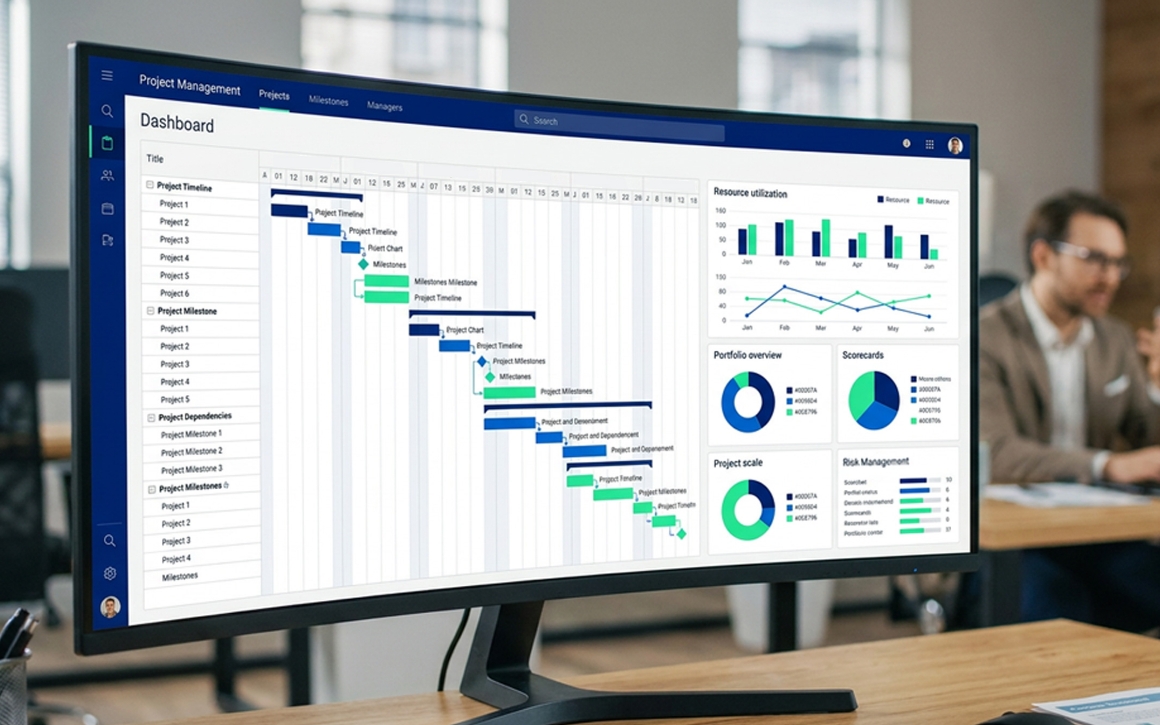
cplace offers a modern user interface with familiar elements such as Gantt charts, Kanban boards, wikis, tables, and visualizations. Each user gets a work environment tailored to their role: project managers see different views and applications than team members or executives. This noticeably increases user adoption.
5. Strategic Portfolio Management at the Highest Level
Project Online is used in many organizations for portfolio transparency and standard reporting, especially where scheduling and resource planning are the focus. As soon as portfolios are to be managed more strategically (e.g., prioritization by goals/OKRs, scenario comparisons, dependencies across programs, or a unified stage-gate/demand process), many teams reach the limits of Project Online alone and supplement it with additional tools or custom extensions.
cplace addresses precisely these requirements with its strategic portfolio management: portfolios can be modeled to fit your own governance, including prioritization logic, decision workflows, roadmaps, and management-grade dashboards. This enables companies to evaluate initiatives consistently, manage capacities and budgets across the board, and document decisions in a traceable way.
Register now
cplace Day 2026
On October 29, cplace Day will enter the next round—Europe’s biggest PPM conference will return to the Bergson Kunstkraftwerk and bring together the visionaries, innovators, and movers and shakers of the industry.
Get your free ticket now!
6. Single Source of Truth Instead of Data Silos
Because of the limited adaptability of Project Online, countless shadow plans emerge in Excel and similar tools in many organizations. The result: data silos, inconsistent information, and no company-wide overview of the project landscape.
With cplace, all solution components—from scheduling and resource planning through risk management to portfolio management—are based on a single, holistic platform. All information converges in a single source of truth, creating transparency and consistency across all levels.
7. Seamless IT Integration Instead of an Isolated Solution
A PPM solution that cannot be integrated into the existing IT landscape loses substantial value. Project Online is heavily tied to the Microsoft ecosystem.
cplace pursues a best-of-breed approach: via the cplace REST API, data can be exchanged with any REST-capable software. For systems without standard interfaces, the Generic Interface is available, offering a wide range of integration options for importing and exporting data.
8. AI-Powered Project Management with cplace AI
Project Online itself does not have integrated AI assistants in its core product; AI is typically added through the Microsoft ecosystem (e.g., Copilot/Power Platform).
cplace AI offers versatile support for project work:
- Chat & Companion: An AI chat inside cplace that understands natural language and is available everywhere in the platform.
- Assistants & Agents: specialized PPM personas that understand the methodology in use and, when desired, act proactively and autonomously.
- Citizen AI: AI support for even simpler low- and no-code customizations.
- MCP Server: an interface that connects cplace with the AI tools already in use across the company—without media breaks or isolated solutions.
- Builder: AI-supported creation of data models and layouts for developing entire cplace solutions.
9. Holistic Project Management From a Single Source
Project Online covers only partial aspects of project management. For comprehensive PPM, organizations have to fall back on additional tools, which increases complexity.
cplace approaches project management holistically—from demand management through scheduling, resource management, and risk management to cost and budget planning as well as strategic portfolio management. For every area and every maturity level, cplace delivers powerful, proven solution building blocks that act as a one-stop shop for enterprise-wide PPM.
10. Enterprise Security, Compliance, and Scalability
In large enterprises, a PPM solution must meet strict requirements for data protection, data security, and compliance. Software with gaps in this area is not an option for enterprises—regardless of how strong it may be functionally.
cplace brings the security and scalability that large organizations require:
- Audit-proof traceability: complete traceability of all changes and decisions.
- Data protection and security: cplace supports companies in complying with GDPR and other regulatory requirements.
- Sophisticated role and rights model: granular control over who can view, edit, or approve which data—across all projects, programs, and portfolios.
- Scalability: cplace grows with the organization and proves itself in large, complex project environments.
- Documentation requirements: cplace supports audit-proof documentation through traceable changes (audit trail) and governance workflows.
Conclusion: Use the End of Project Online as an Opportunity
The end of Project Online on September 30, 2026, is an opportunity for affected companies to fundamentally modernize their project and portfolio management. But modernization should also be sustainable: those who now switch to a rigid, hardly customizable solution risk facing the same problem again in just a few years. cplace combines the flexibility of custom software with the strength of a standard solution and offers companies a future-proof, AI-supported PPM platform that can be extended and modeled without limits and that grows with their requirements.
You can find out exactly how the switch from Project Online to cplace works in our detailed migration roadmap.
FAQ
Microsoft will permanently retire Project Online on September 30, 2026. The official announcement was made in early September 2025.
It depends on the degree of customization. The more Project Online has been customized, the more effort the migration within the Microsoft world entails. Customizations cannot be transferred easily, and the costs for system adjustments and maintenance contracts should not be underestimated.
cplace has established itself as a PPM platform for complex project environments and is used in particular by large enterprises that need to establish a binding standard while accommodating the individual requirements of specific business units.
The migration duration depends on the scope and complexity of the existing Project Online environment. cplace recommends an iterative approach in three phases (analysis, configuration, migration) instead of a big-bang approach.
Yes. cplace offers a REST API for integration with REST-capable software solutions and a Generic Interface for systems without standard interfaces. A comprehensive role and rights model ensures compliance and data security.
Yes. cplace AI includes Chat & Companion, Assistants & Agents, Citizen AI, MCP integration, and an AI-supported builder for data models and layouts.
Yes. cplace supports companies in complying with GDPR and other regulatory requirements. A sophisticated role and rights model, audit-proof logging, and comprehensive documentation features ensure that all compliance requirements are met.
About the Author
Julia Gerstner, Content Marketing, cplace
With its Next-Generation Project and Portfolio Management technology, cplace is revolutionizing and transforming the way people and organizations collaborate on complex projects. The flexible software platform enables leading companies to create customized solutions for digital transformation and developing complex products.
Go to LinkedIn Profile