The best AI PPM software for enterprise complexity: 5 solutions compared
August 13, 2026 | 10 min
21% of CEOs already consider AI to be the most important disruptive technology of our time (Gartner, CIO Report 2024). In project portfolio management, decision-makers feel this pressure every day. The board asks about the AI strategy in project and portfolio management, and most answers fail to convince them. Because what many vendors market as an AI PPM solution are retrofitted features on outdated architectures: a chatbot here, a dashboard there. AI as a cosmetic measure, not as a paradigm shift.
Yet the potential is enormous. Gartner predicts that by 2030, around 80% of routine project management tasks will be handled by AI. However, only one percent of organizations believe they have already achieved generative AI maturity (PMI, Enabling Project Management Transformation With GenAI: The Need for Organizational Support, 2025). To close this gap, choosing the right solution is a crucial step.
This article evaluates five enterprise solutions for project and portfolio management that position AI as a central building block. The evaluation focuses on the value of AI: providing a well-founded basis for decision-making in minutes instead of days, identifying risks before problems escalate, and an AI that doesn’t just recommend but acts directly.
Overview: The five best AI-powered solutions for project and portfolio management
No time for the full comparison? Here’s the quick overview. The selection criteria, detailed reviews, and answers to frequently asked questions follow below.
| Tool | Ideal for | G2.com | Capterra |
|---|---|---|---|
|
cplace |
Large enterprises that want to flexibly adapt their PPM to their own processes and configure and use AI individually |
4,7 / 5 |
4,3 / 5 |
|
Planview |
Corporations that want to seamlessly connect strategy and operational execution in a single system and are willing to align their processes with predefined standards |
4,1 / 5 |
4,1 / 5 |
|
Planisware Enterprise |
Companies that want to manage their product portfolio along a firmly defined methodological framework |
4,0 / 5 |
4,1 / 5 |
|
Microsoft Project & Planner |
Organizations that are deeply rooted in the Microsoft ecosystem |
4,4 / 5 |
No ratings provided |
|
Celoxis |
Teams looking for a quick, low-barrier entry into AI-supported project management |
4,6 / 5 |
4,5 / 5 |
G2 and Capterra ratings: As of August 2026
cplace appears in first place, not as a ranking, but because it is the recommended solution for the requirements this article is geared toward: global manufacturing companies with a complex, R&D-driven project landscape. You can read how this assessment was reached and which criteria were used for evaluation in the next section.
How the best AI PPM solutions were selected
“The rapid development of GenAI is fundamentally changing how organizations approach project management. The challenge is no longer about understanding the technology, but about creating the right environment for its sustainable use.” (Kathleen Walch, Director AI Engagement, PMI)
This list follows no vendor promises, but concrete criteria that matter in day-to-day enterprise PPM.
AI as architecture or as a feature
The evaluation considered the extent to which AI is part of the platform architecture and accesses live project data directly – or whether it was added retroactively. The difference is decisive: A natively integrated AI understands the organization’s structures, dependencies, and methods. A retrofitted AI only knows what someone manually shows it.
Proactive management instead of reactive reporting
A dashboard shows what has already happened. What matters is whether the AI identifies risks and initiates measures before anyone asks. The focus was on genuine agentic capabilities: trigger-based monitoring, autonomous analysis, and active intervention.
Adaptability without IT dependency
Enterprise processes are individual. The evaluation examined whether business users can adapt the AI to their own workflows without tying up developer resources or having to wait months for implementation.
Data sovereignty and compliance
In regulated industries, AI without governance is not an option. The article evaluates whether customer data is used for model training, which certifications are in place, and whether companies retain the free choice of their AI model.
Real-world user reviews
Vendor promises are one thing, user experiences another. G2 and Capterra ratings are factored into the evaluation as an independent quality indicator.
AI PPM solutions compared: the 5 best enterprise solutions
cplace: your projects, your processes, your AI
Ideal for: Large enterprises that want to flexibly adapt their project and portfolio management to their own processes and, when it comes to AI, value customization in addition to standard functions.
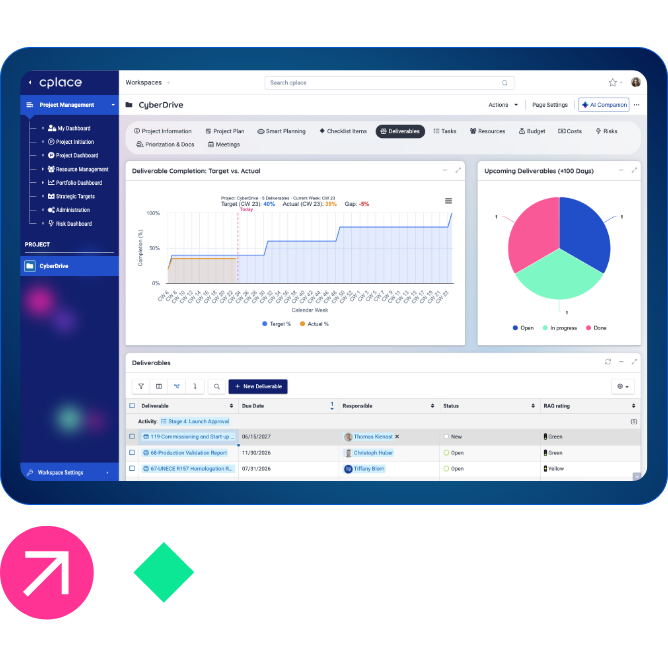
cplace takes a fundamentally different approach to AI. Here, AI is not a retrofitted feature but part of the platform architecture from the very beginning. It works directly on the living database, not on manually uploaded exports or outdated snapshots.
“We are no longer facing the question of whether AI will change project management, but rather how quickly you will leverage this advantage for yourself. The separation between administration and value creation is being dissolved. Humans and AI act as a strong team: You provide the vision, cplace AI takes over the implementation, the validation, and the proactive management.” (Navid Heidemann, Head of Product, cplace)
AI benefits at a glance
- The AI assistant from cplace AI answers questions in natural language, aggregates portfolio health scores in real time, and simulates what-if scenarios at the touch of a button. It accesses the customer’s data model directly and understands their methods, structures, and dependencies.
- Autonomous AI agents continuously monitor projects in the background, identify risk patterns, and notify those responsible early on. This enables an automotive manufacturer to identify capacity bottlenecks across departments in under a minute. Internal alternatives to external service providers identified in advance typically save between 15,000 and 25,000 euros per replaced contractor.
- A key differentiator is the ability to customize AI for business users: Using low-code and no-code, teams integrate generative AI directly into their own workflows – without an IT ticket and without waiting. A pharmaceutical company reduced the effort for schedule reviews by around 80% and identified schedule risks up to eight weeks earlier.
- With the cplace goes a step further than pure AI support: Instead of merely assisting users in operating an existing solution, the AI builds the PPM solution itself. From Excel files, PDFs, workshop notes, or conversations, it automatically generates suitable data structures, workflows, and business logic – in three steps from Research to Plan to Implement, with subject-matter experts reviewing the design and a cplace expert signing off on the finished application before go-live.
- For security and compliance, the platform offers BYOK, free model choice, and no training on customer data. Certifications: ISO 27001, ISO 9001, TISAX, GDPR. Operated on EU data centers.
Typical savings from real-world use:
- Time savings of approximately 7 hours per project manager per week, because cplace automates routine tasks such as reporting, documentation, and scheduling
- Approximately 80% less effort for schedule reviews
- Approximately 70% less effort for reporting and documentation
- Up to 25k EUR savings per replaced external contractor
Industries: Pharmaceuticals, Mechanical Engineering, Aerospace, Defense, Automotive
Not suitable for: Companies looking for a turnkey PPM solution with fixed specifications and no configuration effort. cplace delivers its full value through its adaptability combined with a structured data foundation.
cplace at one glance:
- G2: 4.7
- Capterra: 4.3
- To the cplace Website
Register now
Webinar: cplace AI Builder
September 23, 2026 | 10:00 – 10:30 AM ET
Our AI experts will take one real business scenario and use cplace AI Builder to shape an enterprise application from it, live in front of the audience.
Learn more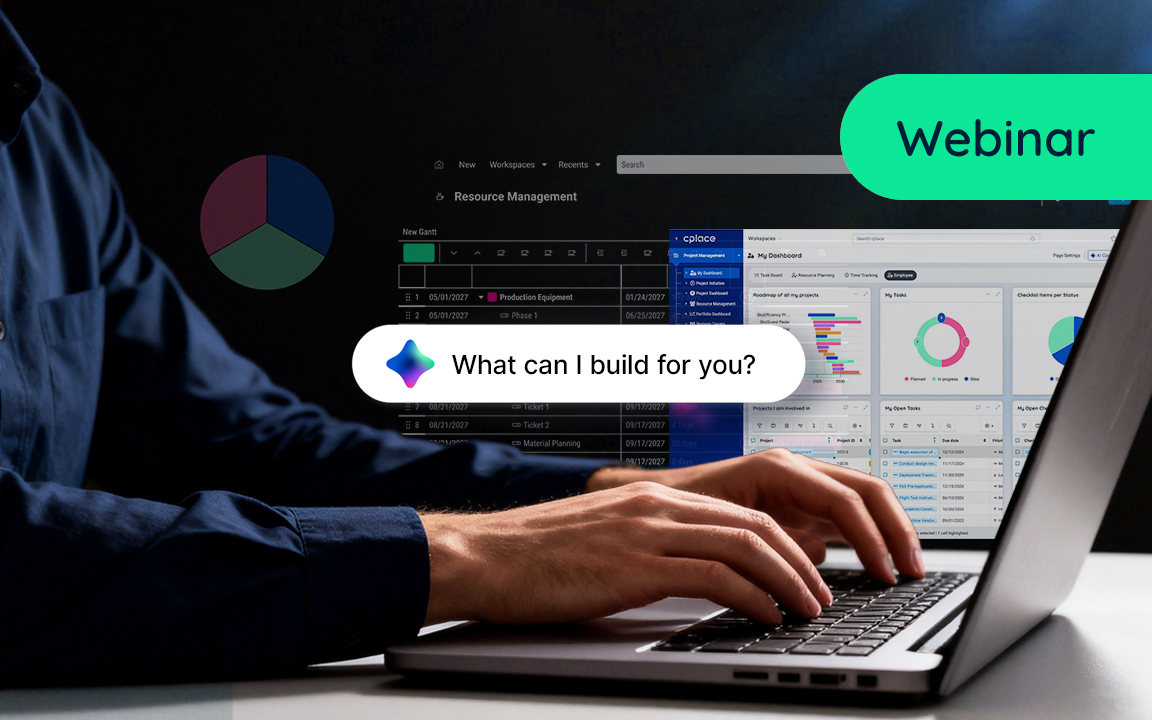
Planview: AI-powered strategic portfolio management
Ideal for: Corporations that want to seamlessly connect strategy and operational execution in a single system, are willing to align their processes with predefined standards, and want to manage their portfolio across multiple business units.
Planview positions itself as the market leader in strategic portfolio management. Anvi was introduced in October 2025 as an enterprise-wide AI solution. A central orchestrator coordinates specialized agents for portfolio, resource, and delivery questions and provides consolidated answers in natural language.
Particularly noteworthy is the Connected Work Graph, which Planview unveiled in early 2026. It visualizes dependencies in real time, from strategic goals down to the task level, and identifies bottlenecks before they affect delivery. The Portfolio Planning Assistant automatically creates executive summaries, detects trend deviations, and suggests corrective measures.
Planview has numerous connectors to third-party systems and synchronizes data in real time. Customer data is not used in the training of AI models. Planview was recognized as a Leader in the 2025 Gartner Magic Quadrant for Strategic Portfolio Management.
Not suitable for: Companies that need full flexibility in choosing their AI model. BYOK is not available. Those who want to adapt AI functions independently and without developer support will quickly reach their limits with Planview.
Industries: Technology, Financial Services, Professional Services, Telecommunications
Planview auf einen Blick:
- G2 rating: 4,1 / 5
- Capterra rating: 4,1 / 5
- To the Planview website
Planisware: predictive AI for structured portfolios
Ideal for: Companies that want to manage their innovation and product portfolio along a firmly defined methodological framework and are willing to align their internal processes accordingly.
Planisware looks back on nearly 30 years of market presence and functionally covers almost every use case related to project management. The platform offers a structured, methodologically sound framework with particular strength in budget management and in the consolidation of key figures across multiple corporate levels.
The AI functions are designed as a structured standard package. Machine learning analyzes historical project data and identifies risks in advance. The AI assistant Oscar orchestrates specialized sub-agents for forecasts, risk analyses, and resource optimization. For resource planning, Particle Swarm Optimization is used, an algorithm that evaluates millions of resource combinations simultaneously.
The AI is powerful within the given framework but offers hardly any options for individual customization. Citizen development – that is, the ability of business users to configure and extend AI functions independently without IT support – is not provided for in Planisware. Those who need individual workflows or flexible interfaces will not find them here.
In addition, there is a demanding implementation: Planisware recommends extensive preliminary work in data quality, governance, and strategic goal definition before deploying AI. This costs time and resources before the first measurable benefit emerges. With a general G2 score of 4.0, Planisware is the lowest-rated PPM tool in this comparison.
Not suitable for: Companies that want to deploy AI flexibly and without long lead times, as well as organizations that want to actively involve their business users in shaping AI.
Industries: Life Sciences, Energy, Chemicals, Aerospace, Defense
Planisware at one glance:
- G2 rating: 4,0 / 5
- Capterra rating: 4,1 / 5
- To the Planisware website
Microsoft: AI-powered PPM within the Microsoft ecosystem
Ideal for: Organizations that are deeply rooted in the Microsoft ecosystem and want to seamlessly integrate AI-supported PPM into existing Microsoft 365 workflows.
Microsoft Project has been firmly established in project management for decades. With Microsoft Planner, Microsoft complements its PPM portfolio with a leaner solution for team-oriented task planning within Microsoft 365. The greatest advantage lies in the deep integration into the entire ecosystem: Those already working with Teams, SharePoint, and Excel will find a familiar environment and don’t have to build a new system landscape.
With Copilot for Dynamics 365 Project Operations and the Planner Agent, Microsoft offers two AI-supported entry points into PPM. Copilot generates project plans from natural-language descriptions, assesses risks based on schedule, budget, and resources, and creates automated status reports. The Planner Agent independently handles assigned tasks and answers questions about project status directly in the chat. Important to know: The advanced AI functions require an additional Microsoft 365 Copilot license. The desktop versions of Microsoft Project have no dedicated AI capabilities.
In addition, there is a strategic turning point: Microsoft is discontinuing Project Online on September 30, 2026. Affected companies face a PPM migration and should carefully weigh the investment decision for the successor
The limits of the PPM offering become apparent as soon as requirements go beyond the Microsoft ecosystem. The AI is firmly tied to Azure OpenAI; there is no free model choice. Dedicated portfolio management functions are largely absent. For complex, enterprise-wide PPM requirements with demanding resource processes or flexibly adaptable structures, the depth of the offering is not sufficient.
Not suitable for: Companies that need a specialized PPM platform with deep portfolio management, citizen development, or free AI model choice.
Industries: Cross-industry, particularly organizations with existing Microsoft 365 infrastructure Microsoft auf einen Blick:
- G2 rating: 4,4 / 5
- Capterra rating: no ratings provided
- To the Microsoft website
Celoxis: conversational AI project management for a quick start
Ideal for: Teams looking for a low-barrier entry into AI-supported project management while valuing intuitive, conversational operation.
With its AI assistant Lex, Celoxis relies on a conversational approach: Users ask questions in natural language and receive data-based answers directly within the platform. Lex identifies risks in real time, supports resource allocation based on availability and skills, and automates routine tasks such as time tracking, status updates, and notifications. Relevant dashboards open directly in the chat, eliminating the need to switch between different views.
For teams that want to get started quickly with AI-supported project management, this is a convincing approach. In the context of complex PPM requirements, however, clear limits become apparent. Celoxis primarily addresses operational project management at the team level, not the strategic management of an enterprise-wide project portfolio. Functions for portfolio prioritization, cross-program dependency analysis, or strategic resource management across multiple business units are largely absent.
In addition: Business users cannot independently adapt AI functions to company-specific processes. Those who want to use Lex beyond the predefined functions are dependent on the vendor. For companies with complex PPM structures and the need for individually configurable AI, Celoxis thus falls short of the capabilities of specialized enterprise PPM platforms.
Not suitable for: Companies with complex, enterprise-wide PPM requirements as well as organizations that place high demands on data sovereignty or individual AI configuration.
Industries: Cross-industry, particularly for project-oriented teams without complex portfolio structures Celoxis auf einen Blick:
- G2 rating: 4,6 / 5
- Capterra rating: 4,5 / 5
- To the Celoxis website
Register now
cplace Day 2026
On October 29, cplace Day will enter the next round—Europe’s biggest PPM conference will return and bring together the visionaries, innovators, and movers and shakers of the industry.
Get your free ticket now!
Finding the right AI-powered project portfolio management software
The five solutions in this comparison show: AI in PPM is not a question of whether, but of how. Retrofitted functions reach their limits where complexity and individuality prevail. What matters is whether the AI truly understands your own organization’s project and portfolio data and structures – in other words, whether it has contextual knowledge.
For companies that want to manage their project portfolio flexibly, identify risks early, and use AI as a strategic lever, we recommend cplace as a first step.
Still unsure where to start? cplace shows you how quickly you can get started.
Finding the right AI-powered project portfolio management software
✓ Meets the requirement ○ Partially meets the requirement
✗ Does not meet the requirement
| Criteria | cplace | Planview | Planisware Enterprise | Microsoft Project & Planner | Celoxis |
|---|---|---|---|---|---|
|
AI as Architecture |
✓ |
○ |
○ |
✗ |
○ |
|
Proactive Management |
✓ |
✓ |
○¹ |
○ |
○ |
|
Adaptability Without IT |
✓ |
✗ |
✗ |
○² |
✗ |
|
Data Sovereignty & Compliance |
✓ |
○ |
✓ |
○ |
○³ |
|
User Rating (G2) |
4,7 |
4,1 |
4,0 |
4,4 |
4,6 |
¹ AI orchestrates agents on request, not continuously in the background.
² The Microsoft Power Platform enables limited customization but is not specifically geared toward PPM workflows.
³ No documented BYOK option.
FAQ: AI-powered project portfolio management software
In project and portfolio management, AI takes over tasks that were previously manual and time-consuming: automatically creating status reports, identifying risks early, forecasting resource bottlenecks, and analyzing dependencies between projects. Modern solutions go further: AI agents continuously monitor projects in the background and act independently based on defined rules. This shifts the focus from reactive administration to proactive management.
Pay attention to three core capabilities: first, native AI integration that works directly with “living” project data instead of manually uploaded exports. Second, genuine agentic capabilities – that is, AI that doesn’t just make recommendations but acts autonomously. Third, adaptability, so that business users can adapt the AI to their own processes without tying up IT resources.
An AI assistant answers questions and provides information when someone actively asks for it. An AI agent, on the other hand, works independently in the background: It continuously monitors projects, detects deviations based on defined triggers, and initiates measures without anyone having to manually trigger the analysis. Agents are thus the decisive step from reactive to proactive management.
Yes, if the basic prerequisites are in place. Real-world examples show: Project managers regain up to seven hours per week through automated routine tasks. Schedule reviews can be accelerated by up to 80%. Resource conflicts identified early avoid unnecessary external service costs. A clean data foundation is decisive for the ROI. Without structured project data, AI remains a promise that goes unfulfilled.
Those who bring their own AI provider (Bring Your Own Model) retain full control over data flows and costs. Equally important is native AI integration, where data does not leave the platform, instead of feeding external tools with manually exported project data. Finally, you should check whether customer data is used for training AI models, which certifications are in place, and whether granular permission management is available. Reputable enterprise solutions support standards such as ISO 27001.
Ask three questions: Does the AI truly understand our structures and processes, or does it work on generic templates? Can our business users adapt the AI independently? And does the solution meet our security and compliance requirements? An AI PPM platform that answers all three questions positively is not a question of budget, but of strategic direction-setting.
About the Author
Julia Gerstner, Content Marketing, cplace
With its Next-Generation Project and Portfolio Management technology, cplace is revolutionizing and transforming the way people and organizations collaborate on complex projects. The flexible software platform enables leading companies to create customized solutions for digital transformation and developing complex products.
Go to LinkedIn Profile