What is an enterprise vibe
coding platform?
Enterprise vibe coding lets business teams build apps at the speed of AI, while IT keeps control over everything that gets built. Learn how it works, what to look for in a platform, and where it pays off.
Explore cplace AI Builder
What is vibe coding?
Vibe coding is software by conversation: you describe what you need, AI builds it, and you keep refining until it fits. No code required, which is why it took off with everyone who has an idea and no time to wait for IT.
Enterprise vibe coding keeps that speed and adds what a prototype can skip but a business can’t: governance, a safe path to production, connections to your existing systems, and someone who still maintains the app a year from now.

Why vibe coding needs an
enterprise version

Day 2 maintenance
Apps are quick to create but hard to keep running when requirements or people change.

Shadow AI
Apps built outside IT’s view reach company data without the usual permissions and audit trails.

No path to production
Untested changes go straight to the people who rely on them.

Unclear ownership
When nobody owns an app, nobody secures, updates, or retires it.
Business teams want the speed of vibe coding. IT needs control.
An enterprise vibe coding platform is built to deliver both.
Vibe coding vs. Enterprise vibe coding
| Vibe coding | Enterprise vibe coding | |
|---|---|---|
|
Goal |
A working prototype, fast |
A production application that lasts |
|
Who builds |
Anyone, often on their own |
Business teams within guardrails IT sets |
|
Data access |
Whatever the builder connects |
Governed by existing roles and permissions |
|
Review |
Optional |
Built-in approval gates before anything goes live |
|
Deployment |
One click, often outside IT’s view |
A staged, controlled path to production |
|
Maintenance |
Depends on the person who built it |
Versioned, auditable, and owned by the organization |
What to look for in an enterprise vibe coding platform
Every platform is getting faster and cheaper at generating applications. What sets them apart is everything that happens before and after.

Governance
- Does every application inherit the existing roles and permissions?
- Are there review gates and a full audit trail?

Deployment
- Where do applications run, and who hosts them?
- Is there a staged, controlled path to production?

Integration
- Do applications work on the existing data model, or do they create new data silos?
- Can they connect to other systems through standard interfaces such as APIs and the Model Context Protocol (MCP)?

Lifecycle
- Who maintains an application once its builder moves on?
- Does it stay compatible when the platform is updated?
Where enterprise vibe coding fits best
Enterprise vibe coding is strongest where business teams know exactly what they need, but traditional delivery takes too long:
- Business-critical spreadsheets: Processes that run in Excel today and need permissions, workflows, and an audit trail.
- Workflow applications: Systems of record with approvals, status logic, and clear ownership.
- Dashboards and reports: Views that management asks for and standard tools don’t provide.
- Modernizing existing applications: Extending or redesigning what already runs, without a full reimplementation.

How cplace approaches
enterprise vibe coding
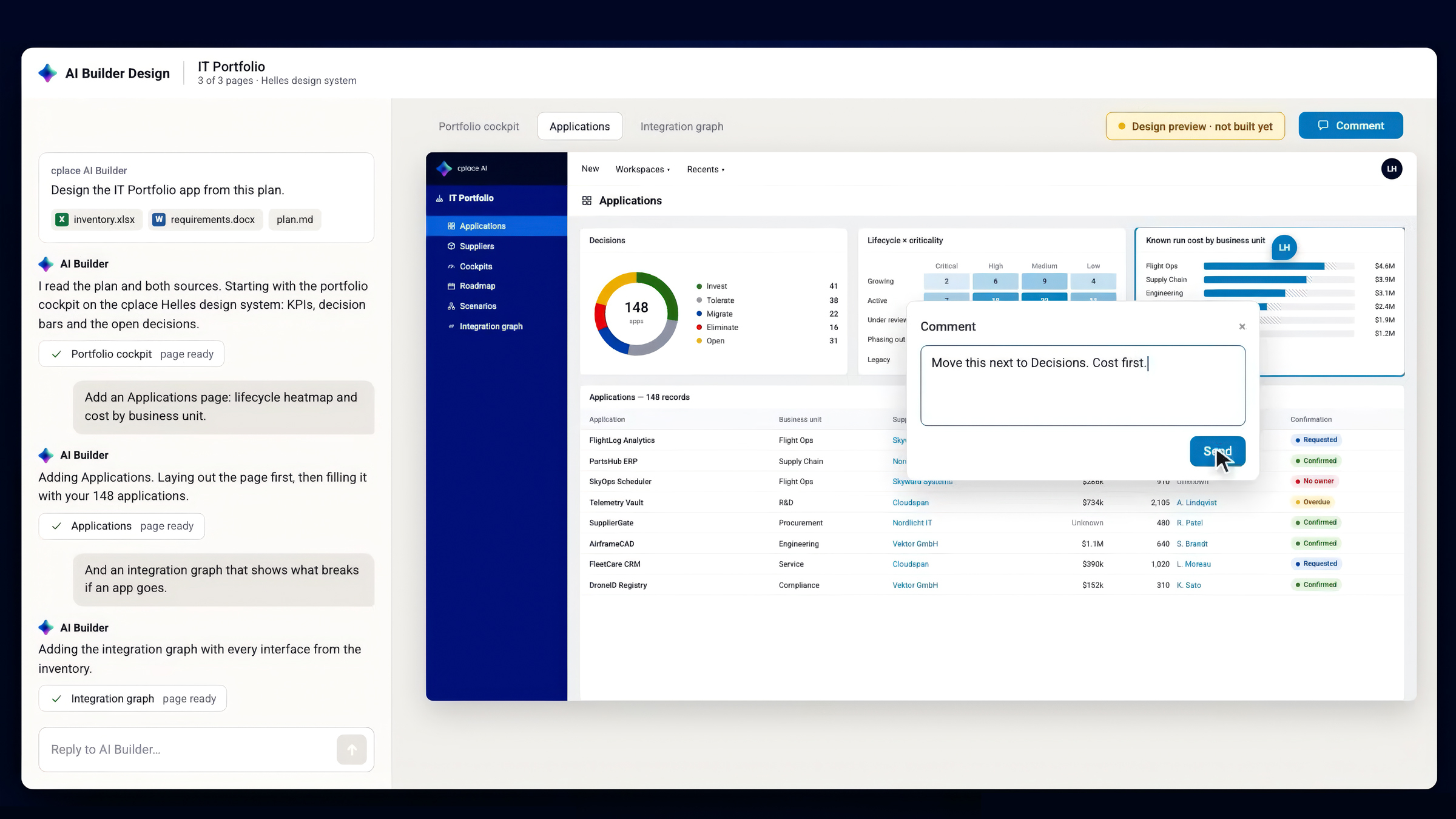
cplace AI Builder applies enterprise vibe coding on the cplace platform, which large enterprises already use to run their most complex project portfolios. Business teams shape the application in a clickable prototype, AI Builder builds it on cplace’s data model, and every result inherits existing permissions, audit trails, and a staged path to production.
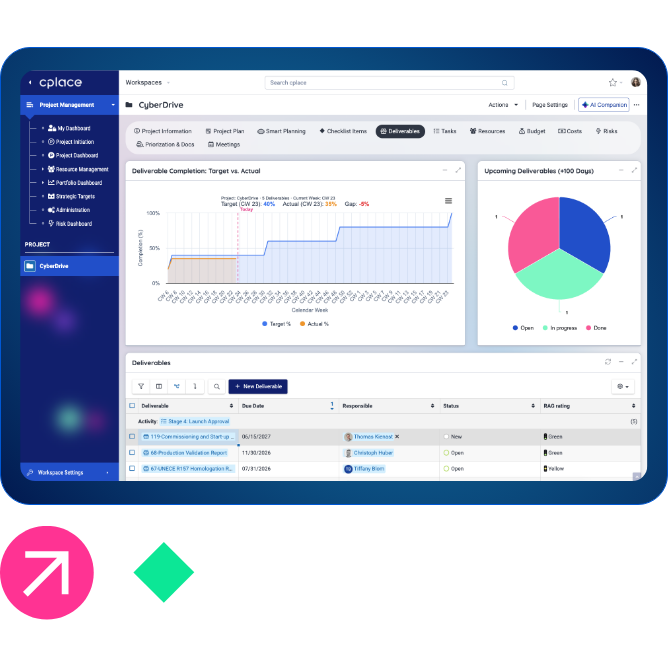
For single views, AI Widget Studio brings the same approach to widgets inside an existing cplace environment.
Frequently asked questions
Vibe coding describes the method: building software by describing it in natural language and letting AI generate it. Enterprise vibe coding applies that method inside a governed platform, with permissions, review gates, controlled deployment, and long-term maintenance built in.
Not quite. In Low-Code, people assemble applications from visual building blocks. In vibe coding, they describe the application and AI generates it. Many enterprise vibe coding platforms build on a Low-Code foundation, so the generated result stays visible and editable.
Mostly domain experts and business teams who know the process best, often supported by solution experts. IT sets the guardrails: which AI providers are allowed, which data is accessible, and how applications reach production.
It depends on the platform. A secure setup e.g., provided by cplace, applies existing roles and permissions to every generated application, requires review before anything goes live, logs every change, and lets you choose your AI provider without your data being used for model training.
The terms overlap. “AI app builder” describes what the tool does. “Enterprise vibe coding platform” stresses the full scope enterprises need: generating deployable applications from natural language, plus governance, deployment, integration, and lifecycle management around them.